QFOR – Quantum Sensors in Research: NV-Based Measure­ment of the Vector Field of Magnetic Flux Density in Magnetic Resonance Systems

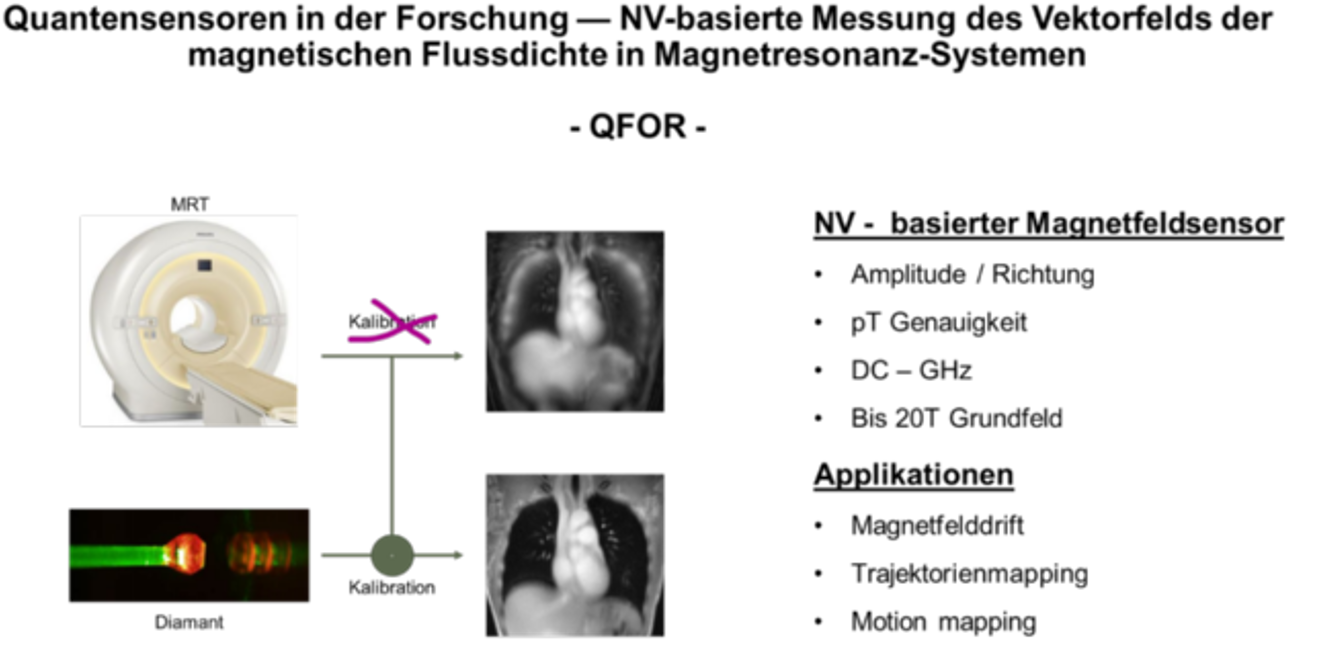
The aim of the project is to develop a high-precision quantum vector magnetic field sensor capable of measur­ing magnetic fields with a sensi­tiv­ity of just a few nanotesla—approximately one-thousandth of the Earth’s magnetic field—and to spatially calibrate magnetic field distri­b­u­tions in magnetic resonance imaging (MRI) systems during opera­tion. The scien­tific objec­tive of the project is to research and realize, at a labora­tory proto­type level, a highly precise measure­ment instru­ment based on nitrogen-vacancy (NV) centers in diamond, enabling the three-dimensional quantifi­ca­tion of the vector field of magnetic flux density 𝐵 and its spatial deriv­a­tives with the highest preci­sion and tempo­ral resolution.

The scien­tific research is conducted with special consid­er­a­tion of the require­ments for integra­tion into magnetic resonance (MRI) and electron spin resonance (ESR) tomographs, aiming to dynam­i­cally quantify typical distur­bances of the vector field—including drifts of the static magnetic field with temper­a­ture, physi­o­log­i­cal effects (breath­ing, heart­beat), gradi­ent switch­ing (kHz range), and radiofre­quency fields (MHz range)—up to at least third order (16 sensors), and to develop corre­spond­ing correc­tion algorithms.

Background Infor­ma­tion

  The global market for magnetic resonance imaging (MRI) systems) was estimated at approx­i­mately €6 billion in 2021. MRI is the method of choice for many diagnos­tic appli­ca­tions. Unlike imaging techniques that use harmful radia­tion, MRI provides excel­lent soft tissue contrast, enabling a wide range of appli­ca­tions across nearly all clini­cal areas. A major drawback of modern MRI systems is the complex calibra­tion required, which is crucial for image quality, as well as the long acqui­si­tion times. Currently, MRI systems are calibrated at the factory using simple classi­cal magnetic field sensors. If it were possi­ble to contin­u­ously measure magnetic fields during opera­tion, both image quality and tempo­ral resolu­tion could be substan­tially improved. To address this, the project aims to develop a high-precision quantum vector magnetic field sensor to drasti­cally enhance MRI perfor­mance. Our approach relies on the pink coloration of diamonds, which origi­nates from specific impuri­ties in the crystal lattice. These impuri­ties behave accord­ing to the laws of quantum mechan­ics and are highly sensi­tive to exter­nal magnetic fields. The unique property of these diamond impuri­ties is that exter­nal magnetic fields directly affect the inten­sity of the coloration. Using sophis­ti­cated quantum measure­ment sequences—similar to those employed in quantum computer prototypes—magnetic fields can be measured very quickly and with high accuracy. We exploit this capabil­ity to calibrate MRI magnetic fields in real time. The improved MRI imaging will not only be commer­cial­ized as a feature for next-generation MRI systems, but also offered as an upgrade for exist­ing systems already installed in clinics.