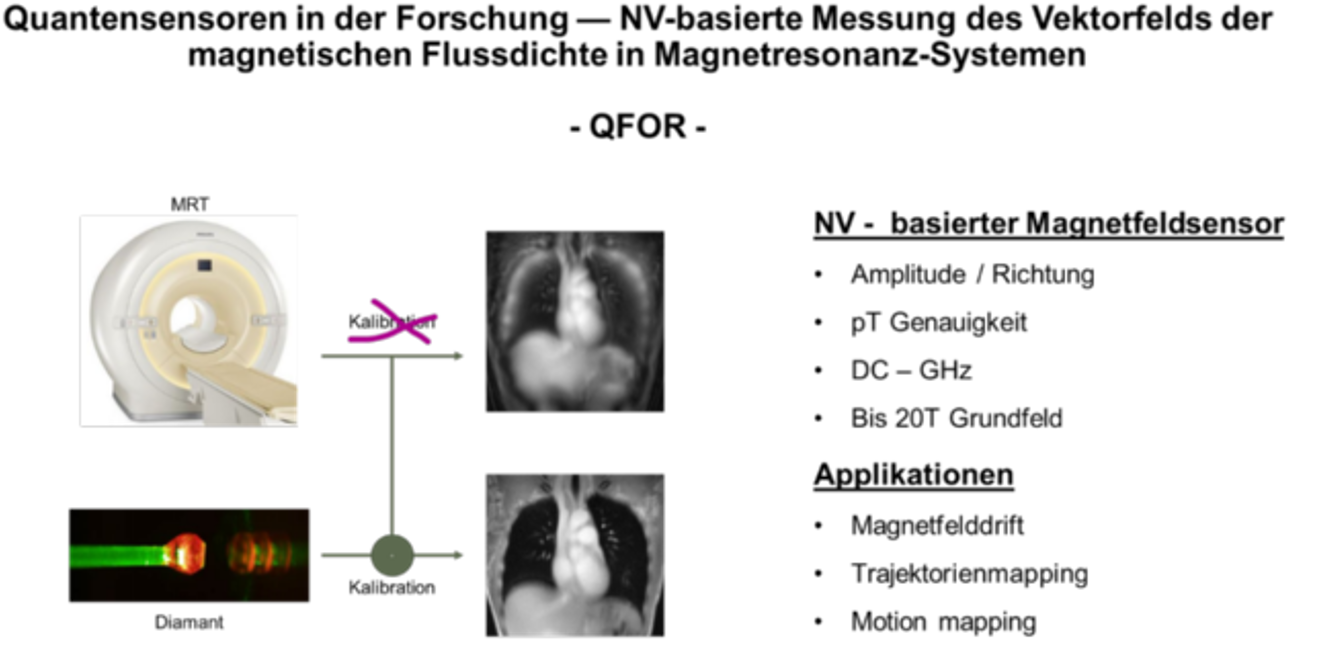
The scientific research is conducted with special consideration of the requirements for integration into magnetic resonance (MRI) and electron spin resonance (ESR) tomographs, aiming to dynamically quantify typical disturbances of the vector field—including drifts of the static magnetic field with temperature, physiological effects (breathing, heartbeat), gradient switching (kHz range), and radiofrequency fields (MHz range)—up to at least third order (16 sensors), and to develop corresponding correction algorithms.
QFOR – Quantum Sensors in Research: NV-Based Measurement of the Vector Field of Magnetic Flux Density in Magnetic Resonance Systems
The aim of the project is to develop a high-precision quantum vector magnetic field sensor capable of measuring magnetic fields with a sensitivity of just a few nanotesla—approximately one-thousandth of the Earth’s magnetic field—and to spatially calibrate magnetic field distributions in magnetic resonance imaging (MRI) systems during operation. The scientific objective of the project is to research and realize, at a laboratory prototype level, a highly precise measurement instrument based on nitrogen-vacancy (NV) centers in diamond, enabling the three-dimensional quantification of the vector field of magnetic flux density 𝐵 and its spatial derivatives with the highest precision and temporal resolution.